
Tired in a Good Way: How Active Outdoor Play Improves Sleep and Attention
A child who plays hard outside sleeps deeper at night and focuses better the next day. Here's the research on why "good tired" is one of the best things you can give a child.
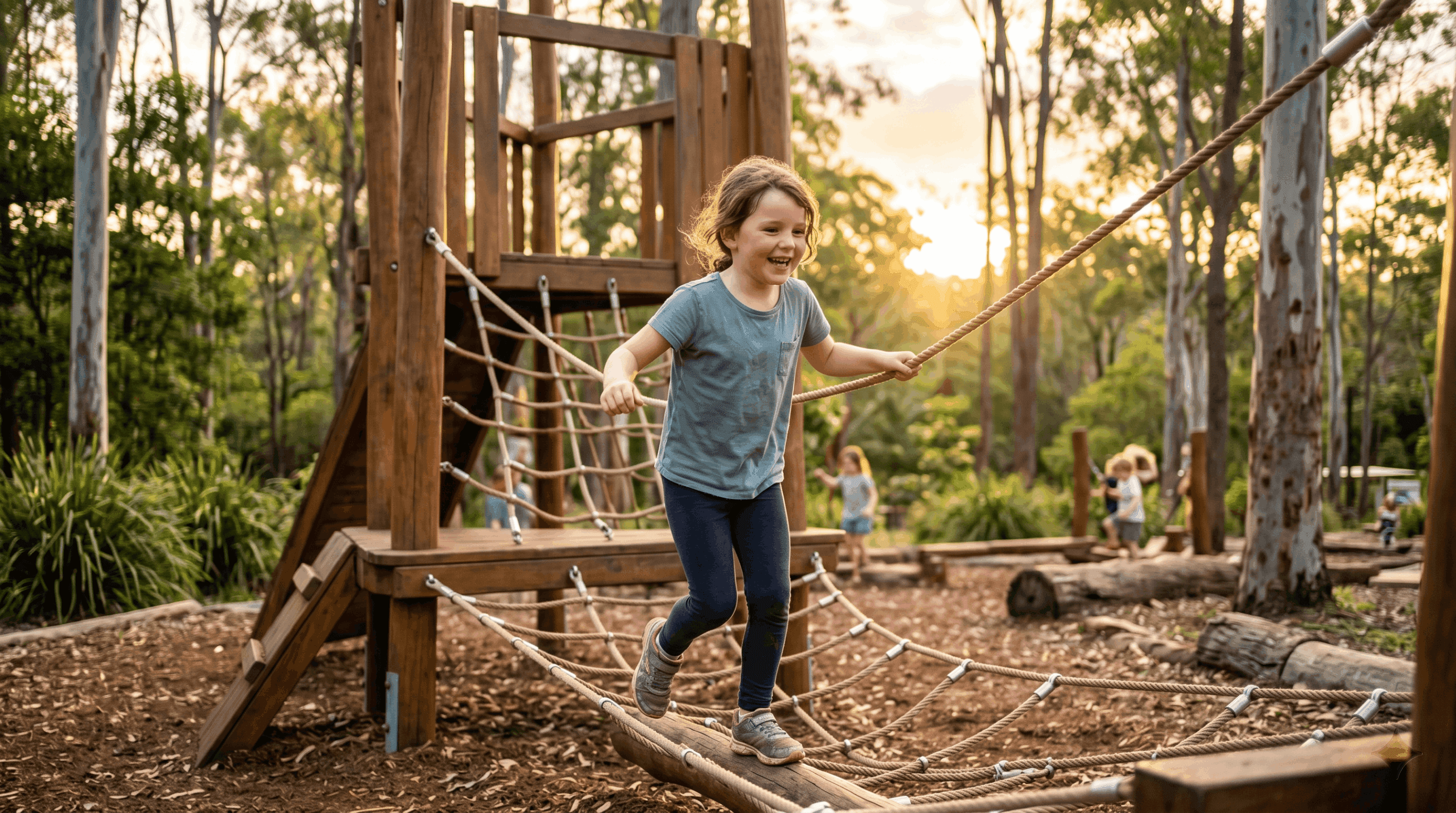
Every parent knows the difference between a child who's been cooped up all day and one who's spent the afternoon running, climbing and chasing friends around the park. The first bounces off the walls at bedtime. The second is asleep before the second page of the story. That instinct is right — and the research backs it up. Daily active play, especially outdoors, is one of the most reliable ways to help children sleep better and concentrate harder. Here's why "good tired" is one of the best things you can give a child.
The bedtime payoff
Australia's official health advice treats movement and sleep as two halves of the same day. The Australian 24-Hour Movement Guidelines recommend that children aged 5 to 17 get at least 60 minutes of moderate-to-vigorous physical activity every day, no more than two hours of recreational screen time, and a solid 9 to 11 hours of sleep a night (8 to 10 hours for teenagers). The guidelines are deliberately built around a whole day, because what a child does between waking and bedtime shapes how well they sleep once they get there. For little ones under five, the World Health Organization sets a similar pattern: at least 180 minutes of activity across the day and 11 to 14 hours of good-quality sleep, with regular sleep and wake times.
For a long time the science on exercise and children's sleep was genuinely mixed — some studies found a clear link, others found very little. But the most recent and rigorous evidence has tipped the scales. A 2025 systematic review and meta-analysis of 27 randomised controlled trials found that exercise produced significant improvements in children's and adolescents' sleep quality, sleep efficiency, sleep duration, time spent awake during the night, sleep anxiety and bedtime resistance. In other words, active kids don't just fall asleep faster — they sleep more deeply and wake less often through the night.
Why outdoors does the heavy lifting
Plenty of that benefit comes from the physical exertion itself. But playing outside adds something a living-room dance party can't: daylight. Natural light is the master signal for the body's internal clock. Morning and daytime light exposure tells a child's brain when to be alert and, just as importantly, when to wind down — anchoring the circadian rhythm that governs healthy sleep. Outdoor light is far stronger than indoor lighting, even on an overcast day, which is why a child who spends real time outside is getting a much bigger "daytime" signal than one who stays in. A striking demonstration of this came from a study of children on a camping trip: living by the natural light-dark cycle, away from screens and artificial evening light, advanced their body clocks and shifted them toward earlier, healthier sleep.
So outdoor play is a double dose — the physical activity that builds "good tired," plus the daylight that keeps the body clock running on time.
The same play sharpens attention
The benefits don't stop when the child comes inside. Active play has an immediate, measurable effect on attention and the kind of focus that schoolwork demands.
In one well-known experiment, preadolescent children completed an attention test and an academic achievement task after either 20 minutes of moderate treadmill walking or a period of rest. After the exercise, the children were more accurate on the attention task and performed better on the academic test — and brain-activity measures showed they were allocating more attention to the task at hand. A single bout of moderate movement, in other words, primed their brains to concentrate.
The effect is just as clear with everyday play. Studies of preschoolers found that children showed better on-task behaviour and attentional control in the classroom after outdoor free play than after the same amount of time playing indoors. The lesson for both schools and families is simple: recess and after-school play aren't a distraction from learning — they're part of how learning happens.
A special note on busy, restless kids
For children who find it hardest to sit still and focus, the outdoors may matter even more. Research led by scientists at the University of Illinois studied more than 400 children diagnosed with ADHD and found that those who regularly played in green outdoor settings — grass, trees, parks and backyards — had milder symptoms than children who usually played indoors or in built outdoor environments such as car parks and paved areas. The link held even after accounting for income and other factors. The researchers suggested a "green dose" could be as ordinary as a leafier walk to school, homework near a window with a garden view, or play on a grassy field after class. It isn't a replacement for professional care, but it's a free, accessible support that points families toward the park.
What this looks like at home
The science keeps arriving at the same plain-language conclusion that parents already half-know: a child who plays hard outside during the day sleeps better at night and focuses better the next day. The three are a loop, each one feeding the others. Good sleep makes for better attention; active days make for better sleep.
You don't need a program or a plan to tap into it. A daily trip to the playground, a scramble at the skatepark, a game of chasey in the backyard before dinner — ideally outside, in real daylight, with the screens left behind — does the work. The tiredness that follows isn't something to manage. It's the sign that a child's body and brain got exactly what they needed.
Ready to start the loop? Find some play places near you and let the good tired do its work.
